
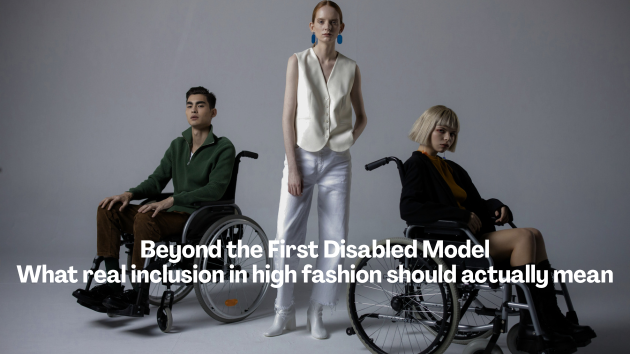
When a high fashion brand finally sends a disabled models down the runway, it feels like a big moment. It’s emotional, it’s overdue, and it’s usually treated like “proof” that the industry is changing. And in some ways, it is.
But here’s the uncomfortable question:
If the representation begins and ends with a handful of castings, a special “inclusive” show, or a one-off campaign, is that really inclusion or just optics?
Let’s talk about what’s actually happening, what still isn’t, and what “enough” would really look like.
Representation on the runway is progress. It’s also the bare minimum.
There has been real movement. Disabled models like Aaron Rose Philip, Jillian Mercado, Sofía Jirau, and others have fronted major campaigns, walked runway shows, and challenged the industry’s narrow idea of who belongs in fashion.
Inclusive shows, like those produced by Runway of Dreams and similar initiatives, deliberately center disabled bodies and adaptive clothing on the catwalk. These moments matter because:
- They give disabled people someone who visibly looks closer to them in spaces that historically erased them.
- They signal to brands that there is demand for disabled representation and adaptive fashion.
- They chip away at the idea that disability and high style can’t coexist.
So no, it’s nothing. It’s important. It’s just not the end of the story.
The paradox of visibility: seen, but still sidelined
A few disabled models on a runway can create a flattering narrative for a brand: “Look how inclusive we are.” But researchers and disabled models themselves describe a paradox of visibility.
In practice, that can look like:
- Disabled models are being used in special diversity or adaptive projects, but not cast in regular, mainstream shows or editorials.
- Runway appearances positioned as a one-time moment, instead of ongoing inclusion.
- Disabled bodies are being styled and presented in ways that are palatable and conventional, without centering actual disabled experience or needs.
So the person is visible, but disability is still treated as a theme, a motif, or a campaign angle, not a normal part of fashion.
Numbers don’t lie: inclusion is still tiny, not typical
Zoom out, and the data is blunt:
- Disabled people make up a large chunk of the global population, but disabled models account for only a tiny fraction of talent in campaigns and runway shows.
- Less than 1% of clothing on the market is specifically adaptive or designed with disabled bodies in mind.
So when a major brand uses one wheelchair-using model in one season, it’s not really representation on the scale of reality. It’s a gesture in a system that still assumes a non-disabled default.
Is the runway even accessible for disabled models?
In many cases, the answer is “not really.”
True inclusion means more than: “We booked you. Good luck with the stairs.” Disabled models have talked about barriers that go way beyond casting:
- Runways and backstage areas that aren’t physically accessible
- No thought put into seating, ramps, dressing spaces, or assistance
- Clothes that don’t work with wheelchairs, prosthetics, mobility aids, or sensory needs
- Production timelines and environments that don’t respect health or access needs
Some brands, like Collina Strada, are often cited as rare examples of designers who actually talk with disabled models, adjust the space, and treat accessibility as part of the design, not an afterthought. That’s the bar. Runway inclusion without accessible infrastructure is performative at best and harmful at worst.
When is it more than a PR move?
You start to see the difference when the disabled presence is:
1- Ongoing, not occasional
Disabled models appear across multiple seasons, not just in a single “inclusive” campaign.
2- Integrated, not siloed
They’re in mainline runway shows, editorial campaigns, and lookbooks, not only in separate “adaptive” marketing or feel-good projects.
3- Backed by design, not just casting
The brand actually designs adaptive or accessible pieces, includes broader size ranges, and thinks about fastenings, closures, and fit with disabled wearers in mind.
4- Shaped by disabled voices behind the scenes
Disabled people are involved as consultants, designers, stylists, casting directors, and decision-makers.
That’s when it starts to look like systemic change instead of a photo opportunity.
The emotional impact is real. That still doesn’t make it “enough.”
For many disabled people, seeing someone like them in high fashion is powerful: it can feel like proof that their body is not incompatible with beauty, style, or visibility. It reduces the feeling of being completely erased from cultural imagery.
But it’s also complicated. Because if the only time you see disabled models is:
- When the brand wants to make a point about “inclusion.”
- In a special themed show
- Or in content framed around their disability instead of their work,
- it can feel like you’re being invited in as a symbol, not as a person who belongs.
So what would “enough” look like?
Enough doesn’t mean every brand releases a one-time adaptive capsule and calls it a day. Real, meaningful inclusion in high fashion would look like:
- Disabled models cast across campaigns, lookbooks, e-commerce, and runway as routinely as any other model category.
- Runways, studios, and backstage spaces are designed with accessibility in mind from the start.
- Adaptive and accessible design is treated as part of the main collections, not a side project.
- Disabled creatives are paid and credited for consulting on design, casting, and storytelling.
- Disabled bodies presented with complexity, style, and individuality, not as token proof that a brand is good.
That’s when the question shifts from “Is it enough?” to “Why didn’t this always exist?”
Final thoughts
So, when high fashion finally puts disabled models on the runway, is it enough?
No. It’s not enough. But it is a start.
It’s a visible crack in a system that spent decades pretending disabled bodies didn’t belong in high style at all. It matters, it’s meaningful, and it deserves to be celebrated.
But the goal isn’t a few headline-making castings. The goal is a fashion world where disabled models aren’t newsworthy at all. They’re just… there. Working. Booking shows. Fronting campaigns. Getting dressed in clothes that were actually designed with them in mind.
Representation on the runway is the opening act. The real work is everything that happens after.
FAQs
Why is it a big deal when high fashion uses disabled models?
For a long time, disabled people were almost completely erased from fashion imagery. Seeing disabled models on major runways and in campaigns challenges the old idea that fashion is only for one kind of body and sends a signal that disabled people deserve visibility and style too.
Is putting disabled models on the runway enough?
No. It’s a start, not the finish line. True inclusion needs consistent casting, accessible spaces, adaptive design, and disabled people involved behind the scenes, not just one-off “inclusive” shows or campaigns.
What’s the difference between real inclusion and tokenism?
Tokenism is when a brand uses one disabled model in a highly visible moment, then goes back to business as usual. Real inclusion means disabled models appear across seasons and channels, collections consider disabled wearers, and accessibility is built into the system, not added as PR.
Why does accessibility behind the scenes matter?
If a runway uses a disabled model but the backstage has stairs, no ramps, no space for mobility aids, or no support for health needs, that’s not true inclusion. It turns the model into a symbol while ignoring their basic access and comfort.
What is adaptive or accessible fashion?
Adaptive fashion includes design details that make clothing easier or more comfortable for disabled wearers: alternative closures, seated-friendly cuts, sensory-friendly fabrics, space for prosthetics or devices, and designs that work with mobility aids.
How can fashion brands move beyond surface-level inclusion?
By casting disabled models regularly, designing adaptive options in main collections, paying disabled creatives to consult and design, making shows and shoots physically accessible, and treating disability as a normal part of their audience, not a special campaign theme.
Why does this matter to non-disabled people?
Because inclusion raises the standard for everyone. When fashion becomes more accessible, thoughtful, and diverse, clothes get more comfortable, designs improve, and the industry becomes less shallow and more human for all of us.