
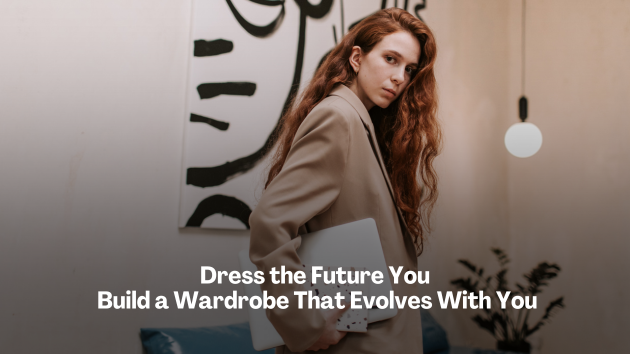
Sometimes the problem is not that you have nothing to wear. It is that everything you own belongs to an older version of you.
You open your closet and see clothes that made sense for a different routine, a different job, a different body, a different mindset. They are not necessarily bad. They just no longer feel connected to the life you are living now. Building a wardrobe that fits who you are becoming starts there.
Notice the disconnect
Most people do not realize their wardrobe is out of step until getting dressed starts to feel harder than it should.
You keep trying things on, but nothing feels quite right. Outfits look fine, but not like you. The pieces in your closet may still be wearable, yet they no longer reflect how you want to show up in the world.
That feeling is worth paying attention to.
It usually means your life has shifted in some way. Maybe your work has become more serious. Maybe your lifestyle is slower now. Maybe you are more confident than you used to be, or maybe you are craving simplicity after years of dressing for attention. Whatever the change is, your clothes may still be telling an old story.
Stop dressing for your past self.
Many wardrobes are shaped by memory.
People hold on to clothes because they remind them of who they used to be, or because they spent a lot on them, or because parting with them feels like admitting something has changed. But keeping clothes for emotional reasons is not the same as wearing them with purpose.
If you would not buy it today, that tells you something. If it only makes sense for a version of your life that no longer exists, that tells you something, too.
This does not mean throwing everything away. It means being honest about what still supports you and what is only taking up space. A wardrobe should not trap you in an outdated identity. It should help you move forward.
Dress for your real life.
One of the biggest reasons wardrobes fail is that they are built around fantasy.
People buy for the person who goes to chic dinners every weekend, works in a polished office, or lives in outfits that look perfect online but feel impossible in daily life. Then the clothes sit there, untouched, while the same practical pieces get worn on repeat.
Your wardrobe should reflect your actual life.
Think about your week as it really is. What do you wear most often? What do you need your clothes to do for you? What makes you feel comfortable, capable, and like yourself?
The goal is not to build a beautiful closet in theory. It is to build one that works in practice.
Focus on how you want to feel.l
A lot of style advice starts with appearance. It asks how you want to look. That matters, but feeling is often the better place to begin.
How do you want to feel in this next chapter of your life?
More polished? More relaxed? More confident? More creative? More grown? More grounded?
Those words are more useful than they seem. They help you make better decisions. A person who wants to feel calm and put together will build a different wardrobe than someone who is constantly chasing novelty. A person who wants to feel strong may stop buying delicate pieces that look good on hangers but feel awkward when worn.
When you know the feeling you are aiming for, your choices become clearer.
Pay attention to what you already repeat.
You do not need to reinvent your style from scratch. In fact, it is usually better not to.
The easiest way to understand your style is to look at what you already wear on repeat. Not the things you admire in theory, but the things you actually reach for when you need to leave the house and feel good.
Those pieces reveal a lot. They show you your preferred shapes, fabrics, lengths, and levels of effort. They tell you what feels natural on your body and in your life.
Maybe you always reach for wide-leg trousers, oversized shirts, simple gold jewelry, and flat shoes. Maybe you keep returning to soft dresses, neutral knits, and clean silhouettes. That repetition is not boring. It is information.
Style becomes stronger when you build from what already feels true.
Edit with intention
Once you know what no longer fits and what keeps showing up, editing becomes easier.
Start by removing the pieces that create friction. The items that almost work, but never quite do. The ones you keep saving for a life you do not live. The ones that fit the past better than the present.
Then look at what is missing.
Usually, the answer is not more clothes. It is better support. Better basics. Better layers. Better versions of the few things you wear constantly. A wardrobe becomes more useful when it is built around pieces that work together, rather than random items that each demand their own moment.
That is what makes getting dressed easier. Not more options, but better alignment.
Let your style evolve slowly.
There is a temptation to change everything at onc: neww season, new identity, new wardrobe. But most lasting style shifts do not happen that way.
They happen gradually.
You notice what feels off. You let go of what no longer works. You become more aware of what you love. You buy with more clarity. Over time, your wardrobe begins to feel less like a collection of disconnected purchases and more like an extension of who you are.
That kind of style feels different. It is quieter, but stronger. It does not rely on constant reinvention. It just fits.