
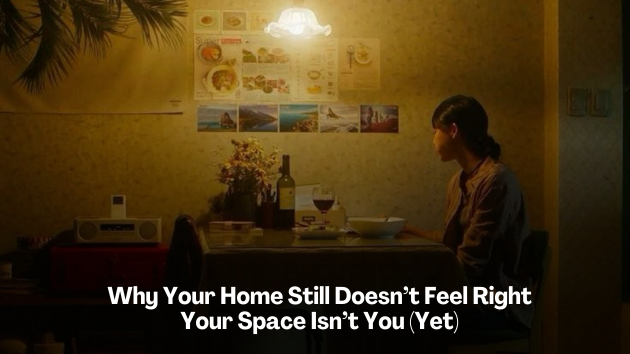
You've moved the furniture twice. Bought a few things you saw on Instagram. Added a throw pillow. Maybe a plant. Lit a candle.
And it still doesn't feel right.
It looks fine. It's clean. It functions. But there's this quiet, nagging feeling every time you walk through the door that something is off. Like you're staying in someone else's space that just happens to have your stuff in it.
You're not imagining that. And it's not a decor problem.
The Real Reason Your Home Doesn't Feel Like Home
Here's a truth the home decor industry doesn't really want you sitting with: most people don't have poorly decorated homes. They have disconnected ones.
What that means is their home was assembled by accident. A couch was chosen because it fit the budget that month. A color on the wall left by the previous tenant. Furniture from a first apartment that followed you into your thirties out of convenience.
None of it was chosen. It just... accumulated.
And when your environment is made of accumulated defaults rather than actual choices, it doesn't reflect you. It reflects circumstances. And living inside a reflection of your circumstances, rather than your personality, is quietly exhausting.
How You Actually Know This Is the Problem
Ask yourself this: is there one room, or even one corner, in your home where you feel completely at ease? Where you genuinely want to spend time?
Most people have at least one spot like that. A reading chair they chose deliberately. A kitchen shelf they arranged exactly how they wanted. A corner with the right lamp and the right little table.
Notice that spot feels different. You didn't stumble into that feeling. You made choices there, even small ones, that reflected something true about you.
The rest of the house just needs that same treatment.
The Fix Isn't More Stuff
This is where people go wrong. They see a room that doesn't feel right and they go shopping. New rug, new cushions, new wall art. The room now has more in it and still doesn't feel right.
More stuff doesn't solve a disconnection problem. Intentional editing does.
Before you add anything new, remove what doesn't belong. And by "doesn't belong," I don't mean things that are ugly or outdated. I mean things you kept by default. The decorative object you've never liked but felt wasteful to toss. The piece of furniture that doesn't fit how you actually live. The color scheme you never chose.
When you strip back to what you genuinely like and what actually serves how you live, something interesting happens. The room starts to breathe. And what's left starts to feel like a foundation you can actually build on.
The Three Questions That Will Fix Your Home Faster Than Any Shopping List
Before your next home decor decision, run it through these three filters:
Does this reflect how I actually want to feel here? Not how a magazine room looks. How you, specifically, want to feel in this specific room.
Does this work with how I actually live? A pristine white couch is beautiful. It is not compatible with every lifestyle. Be honest.
Am I keeping this by choice or by default? Choice stays. Default goes.
That's it. That's the entire system.
The Identity Piece Nobody Mentions
Your home is a self-portrait. Whether you meant it to be or not, it tells a story about who you are, what you value, and how you see yourself.
When that story is coherent, your home feels grounding. When it's a collection of random decisions made under financial pressure or time constraints, it feels unsettled. And you feel unsettled in it.
The fix isn't a renovation budget. It's a decision to start treating your home like it belongs to the person you actually are, not the person who just needed somewhere to put their furniture.
Start with one room. Ask those three questions. Edit before you add.
Your home already has the potential to feel exactly like you. It just needs you to show up for it.